On this page
Before You Begin #
Prerequisites #
- Rough opening is framed and ready - header, jack studs, king studs, and a rough sill are all in place
- Drywall is hung and finished on both sides of the wall around the opening
- You know the wall depth (measure from finished drywall surface to finished drywall surface)
- Glass has been spec’d, or you have already picked a glazier (the contractor who cuts and installs glass) - they will measure after Step 5 and bring back the glass cut to size
What You Need To Know #
- This is a four-sided frame. Unlike a door opening (three sides), the interior window frame includes a sill piece at the bottom. All four joints must be tight and square.
- Door stop creates the glass channel. Door stop is a thin strip of molding (the same kind that would normally stop a door from swinging past the jamb - here it holds glass instead). Standard door stop is 7/16″ × 1-3/8″. You install it on one side of the frame first. Then the glass goes in. Then you install stop on the second side to sandwich the glass in place.
- Glass is installed by a glazier. You build the frame and install the first side of stop. The glazier measures, cuts tempered glass to fit, and installs it. Then you return to install the second side of stop.
- Tempered glass is required. Building codes require tempered (safety) glass for interior applications where the glass could be impacted. The glazier handles this, but verify the spec if you’re ordering directly.
- The jamb (the frame piece that lines the wall opening) width must match the wall depth exactly. Measure the wall depth from finished surface to finished surface. The jamb material must be ripped (cut lengthwise on the table saw to narrow it down) to this exact dimension - no extension pieces like an exterior window.
Which guide do I need?
- Windows you can reach without a ladder: this guide
- Windows 90 to 119 inches tall: Interior Window Frame for Medium-Tall Openings (90″ to 119″)
- Windows 120 inches and taller: Interior Window Frame for Tall Openings (120″ and Above)
Tools Required #
Power Tools #
- Miter saw - For cutting jamb pieces and door stop to length
- Table saw - For ripping jamb material to the correct wall depth
- Pin nailer (23-gauge) or brad nailer (18-gauge) - Pin nailer for door stop (leaves nearly invisible holes); brad nailer for securing the jamb frame to framing
- Finish nailer (15-gauge, 2-3/4″) - For nailing the jamb to rough framing through the shims (thin tapered wood or plastic wedges you drive in to fine-tune the gap and hold the frame straight and square)
Hand Tools #
- 4-foot level - For checking plumb on the sides and level on the head and sill
- Tape measure
- Utility knife - For scoring shims
- Block plane - For fine-tuning flush between jamb and drywall
- Combination square - For marking reveals and checking right angles
Supplies #
- Wood glue (yellow carpenter’s glue)
- Cedar or composite shims
Materials #
- Jamb stock - 1× material (dimensional board stock, not sheet stock - MDF, poplar, or pine) ripped to match wall depth. For a standard 2×4 wall with 1/2″ drywall on each side, wall depth is approximately 4-9/16″. Measure your actual wall.
- Door stop molding - Standard 7/16″ × 1-3/8″ door stop. Buy enough for both sides of all four frame edges (8 linear pieces total: 4 for the first side, 4 for the second side after glass).
- Casing trim - For finishing the frame after installation. This is installed after the interior window frame and glass are complete. See How to Case a Window Like a Pro for the casing process.
Interior Window Frame Installation Process #
Step 1: Measure the Rough Opening and Wall Depth #
Take three measurements across the width of the rough opening - top, middle, and bottom. Take three measurements for height - left, center, and right. Use the smallest measurement in each direction for your jamb pieces (the frame must fit inside the opening, then be shimmed out to the right position).
Measure the wall depth at all four corners and the center of each side. The wall depth is the distance from finished drywall surface on one side to finished drywall surface on the other. Use the widest measurement - you can plane down a jamb that’s slightly proud (sticking out past the drywall), but you can’t add material to one that’s too narrow.
Step 2: Rip and Cut the Jamb Pieces #
Rip your jamb stock on the table saw to match the wall depth measurement. Cut four pieces:
- Head piece (top) - Cut to the width of the rough opening minus 1/4″ (1/8″ shim clearance on each side).
- Sill piece (bottom) - Same dimension as the head piece.
- Two side pieces - Cut to the height of the rough opening minus the thickness of the head and sill pieces, minus 1/4″ for shim clearance.
Dry-fit the four pieces together (put them in place without glue, just to check the fit) to verify the frame will fit in the opening. The frame should be approximately 1/4″ smaller than the rough opening on all sides to allow room for shims.
Step 3: Assemble the Four-Sided Frame #
Lay the four pieces on a flat surface and assemble them into a rectangle. Apply wood glue to each joint and secure with 18-gauge brad nails or 23-gauge pins. The head and sill pieces sit between the two side pieces (sides run full height, head and sill are captured between them).
Check the frame for square by measuring diagonals (corner to corner, in an X across the frame) - they should be equal within 1/16″. If they’re off, adjust the frame before the glue sets. Let the glue grab (start to set up) for a few minutes before moving the frame.
Step 4: Install the Frame in the Rough Opening #
Slide the assembled frame into the rough opening. Center it in the opening and begin shimming:
- Shim the sill first. Get the bottom level. Use at least three shim points across the sill - both ends and the center.
- Shim the sides next. Check plumb on both sides. Use at least three shim points per side - top, center, and bottom. Shim behind the joint locations where the head and sill meet the sides.
- Shim the head last. Check level across the top. The head should already be close if the sides are plumb and the sill is level.
- Nail through the shims with a 15-gauge finish nailer, 2-3/4″. Drive nails through the jamb, through the shims, and into the rough framing. Score and snap off the exposed shim ends.
After nailing, verify plumb, level, and square one more time. Check that the frame is flush with the drywall on both sides of the wall.
Step 5: Install Door Stop - First Side #
Install door stop molding on one side of the frame only. This creates the ledge that the glass will rest against. The stop should be positioned to center the glass within the jamb depth (equal reveal on both sides after the second stop is installed).
To find the stop position: Start with the wall depth. Subtract two stop thicknesses (typically 7/16″ each, 7/8″ total). Subtract the glass thickness (typically 1/4″ for standard tempered glass). What is left is the remaining depth. Divide that number by two for equal reveals. Set the first stop that distance from the face of the jamb.
Miter the corners of the door stop at 45 degrees. Nail with a 23-gauge pin nailer - pins leave nearly invisible holes in the stop. Install stop on all four sides of the frame on this one side of the wall.
Step 6: Glass Installation (by Glazier) #
At this point, the glazier takes over. They will:
- Measure the opening inside the stop on all four sides
- Cut a piece of tempered glass to fit (typically 1/8″ to 1/4″ smaller than the opening for clearance)
- Set the glass against the first-side door stop
- Install glazing points (small metal clips) or setting blocks (small rubber or plastic blocks) to hold the glass in position until you install the second stop
Confirm with your glazier whether they want you to apply a bead of clear silicone to the first-side stop before they set the glass. Some prefer it; others want a dry set so the glass can be removed later if needed.
Step 7: Install Door Stop - Second Side #
After the glass is set, install door stop on the second side to sandwich the glass in place. Use the same miter technique as the first side. Press the stop gently against the glass - firm enough to eliminate rattle, but not so tight that you stress the glass.
Pin-nail the stop the same way as the first side. Avoid nailing within 1″ of the glass edge to prevent cracking. If the glass rattles slightly after the stop is installed, apply a thin bead of clear silicone between the glass and the stop.
Step 8: Set, Clean, and Hand Off for Casing #
Once the second side of stop is nailed and the glass is tight, close the frame out before you move to casing.
- Set every proud fastener: Run a hand around all four sides of the jamb and both faces of stop. A pin or brad sitting even slightly proud will telegraph through the finish (show up as a bump once it’s painted). Set it below the surface with a nail set.
- Clean any glue: Wipe glue squeeze-out off the frame joints while it is still wet. Dried glue leaves a hard spot that shows through the finish and has to be scraped.
- Check the frame one more time: Diagonals still equal, jamb flush to the drywall on both sides, stop tight against the glass with no rattle.
- Sweep up: Cutoffs collected, dust off the sill and floor.
Filling the fastener holes and sealing the joint where the jamb meets the drywall belong to the painter. He fills and coats the whole room in one pass with one set of materials. If we fill ahead of him, that patch shows through differently once it’s painted, and he has to redo it. What he needs from us is a square frame, fasteners set below the surface, glue cleaned off every joint, and a swept floor. The interior window frame is now ready for casing - see How to Case a Window Like a Pro for the trim installation process.
Interior Window Frame Quality Check #
- Frame is square - Diagonals are equal within 1/16″
- Both sides are plumb - Level reads true on full length of both side jambs
- Head and sill are level - Level reads true across the full width
- Jamb is flush with drywall on both sides - Run your hand across the transition; no lip or step
- Door stop is tight against glass - No rattle when you tap the glass lightly
- Reveals are consistent - Equal gap visible between glass edge and stop on both sides
- Every fastener is set below the surface - nothing proud to the touch on jamb or stop
- Glue is cleaned off every joint - no dried squeeze-out on the frame
Troubleshooting Interior Window Frame Problems #
Frame Won’t Fit in the Rough Opening #
The assembled frame is too large. Measure the opening again and compare to the frame dimensions. If the frame is more than 1/4″ oversize, you’ll need to trim it. If it’s just barely tight, check for drywall mud or corner bead (the metal or plastic strip drywallers run on an outside corner) protruding into the opening - a utility knife or rasp can clear the obstruction.
Jamb Not Flush with Drywall #
The jamb is either proud or recessed (below the drywall surface). If proud, plane it flush with a block plane. If recessed, you ripped the jamb too narrow. You can add a thin strip of matching material to build it up. Or you can install the casing with a slightly larger reveal to hide the gap.
Glass Rattles After Installation #
The door stop is not tight enough against the glass, or the glass is slightly undersize. Apply a thin bead of clear silicone between the glass and the stop on the rattling side. If the rattle is significant, remove the second-side stop, add setting blocks or glazing points, and reinstall the stop tighter against the glass.
Frame Out of Square #
If you catch it before nailing, loosen the shims and rack the frame (push it diagonally) back into square. If the frame is already nailed, you may need to pull nails on one side, adjust shims, and re-nail. Check diagonals after every adjustment.
Door Stop Splits When Nailing #
Use a 23-gauge pin nailer instead of a brad nailer - the smaller gauge is less likely to split thin molding. If you must use brads, pre-drill with a 1/16″ bit near the ends of each piece. Avoid nailing within 1″ of a miter cut.
An interior window frame is unforgiving about one thing above all: square. A door opening tolerates a little play because the door itself hides small errors. An interior window frame does not, because the glass and the reveal around it are the only thing anyone sees. Check diagonals on the interior window frame before you nail it. Check them again after. Do not let an interior window frame leave your hands until both readings match.
Get the interior window frame square and level, and the rest - stop, glass, casing - falls into place on its own. Few crews take the time to get a window frame truly square, which is exactly why a clean one stands out. That is the whole job: an interior window frame built square, shimmed tight, and handed off ready for glass.
Related Guides #
For additional detail on framing and trim techniques, see this guide from our tall interior window frame article.
- How to Install a Window Jamb Extension Like a Pro - Similar jamb construction for exterior windows where the existing window frame doesn’t reach the drywall surface
- How to Case a Window Like a Pro - The next step after the interior window frame is installed: adding casing trim around the frame
- How to Install a Door Jamb Extension Like a Pro - Similar concept for door openings
- How to Install a Cased Opening - Same four-sided frame concept but without glass
- Interior Window Frame for Medium-Tall Openings (90″ to 119″)
- How to Install a Transom Window Above a Door
- How to Install a Mullion Strip
Reference Photos #
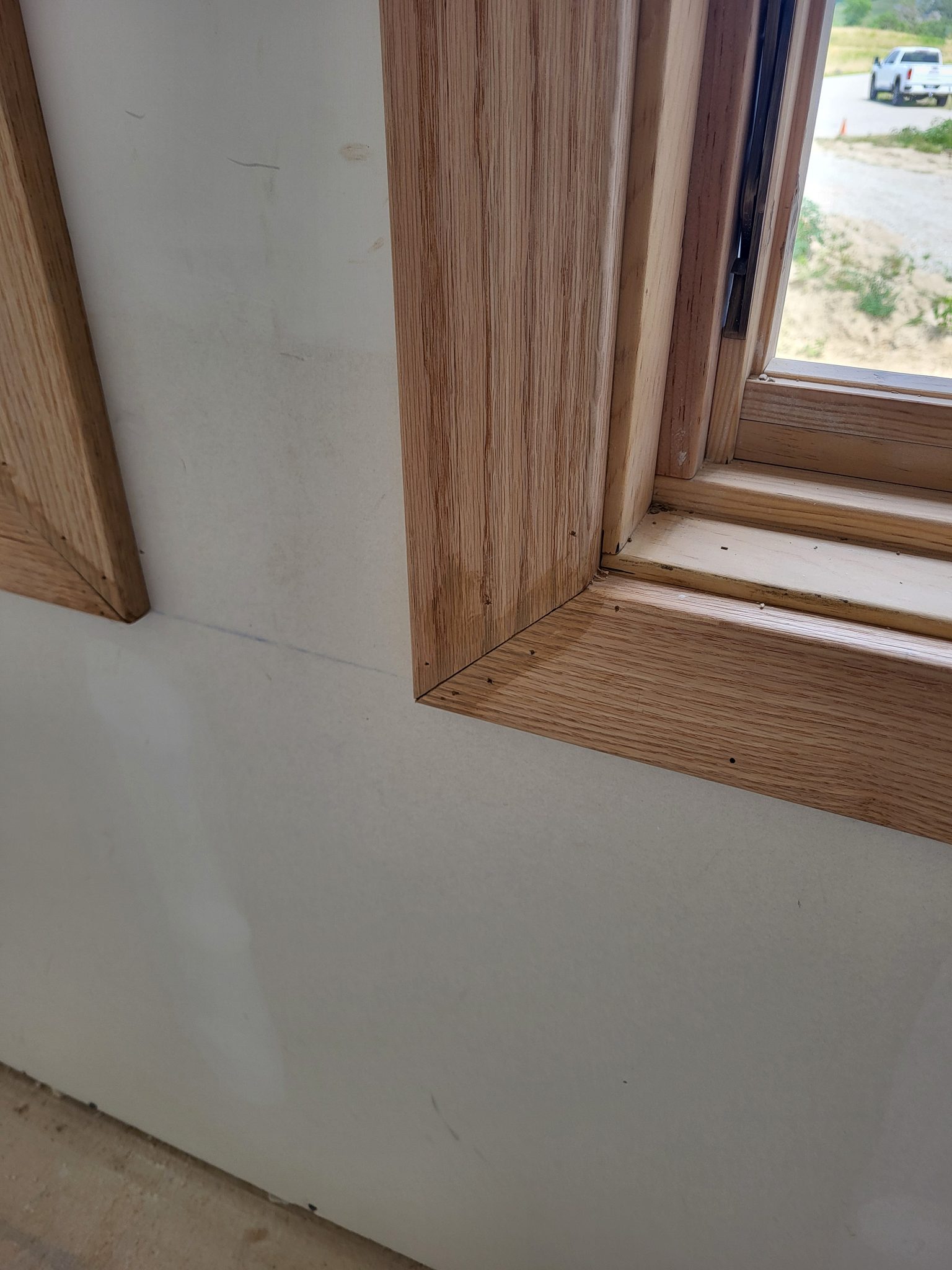
The following photos show examples of this type of work completed in the field. These serve as visual references for quality standards, proper installation techniques, and finished results.
Showing 1 of 1 photos