
General Carpentry #
Skill Level: Expert (Level 3) #
Estimated Time: 8-14 Hours #
Introduction #
Additionally, this is a supplemental guide for shiplap fireplace wraps 10 to 15 feet wide — floor-to-ceiling or floor-to-mantel installations where the 3-sided surround spans a significant portion of the room. The complete shiplap fireplace installation process is covered in our core guide: How to Install Shiplap on a 3-Sided Fireplace Under 10′. Read that guide first. Everything below assumes you know the mitered corner, course-by-course, and heat-clearance fundamentals and focuses only on what changes when the surround width exceeds 10 feet.
Furthermore, at this scale, the shiplap fireplace surround becomes a major architectural element in the room — not just an accent piece. Longer board runs on the front face introduce butt joints (which the under-10-foot guide doesn’t address), and the added height often means installing above a mantel shelf as well as below. Every error is more visible because the surround dominates the room’s visual focus.
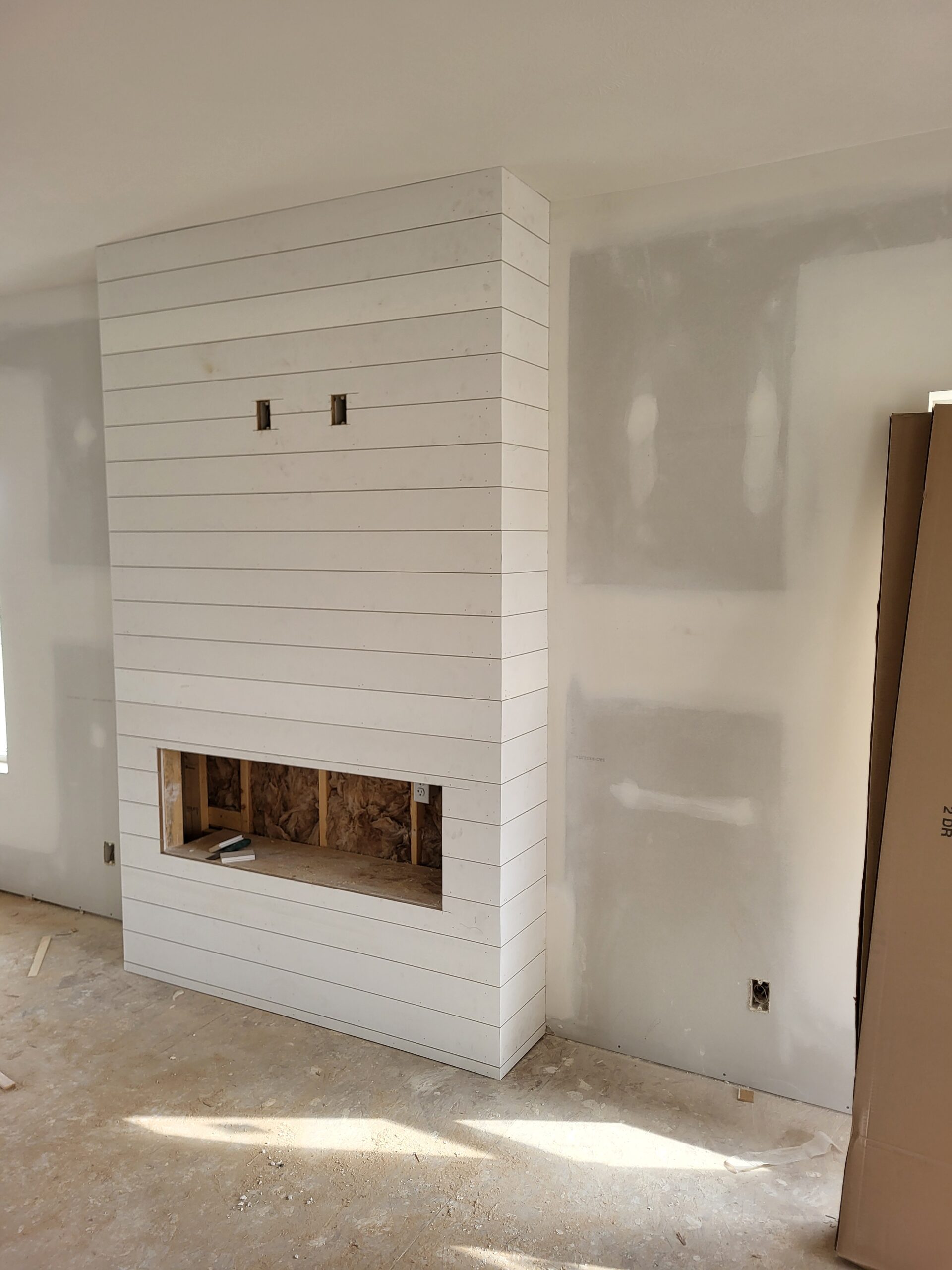
📷 Photo Needed
Large shiplap fireplace surround 12-14 feet wide, floor to ceiling, showing mitered corners and mantel integration
What Changes at the 10-15 Foot Scale #
- Butt joints appear on the front face. If the front face exceeds your board length (typically 8 feet), you need butt joints. Follow the 7-14 foot joint management guide for stagger and nailing — but on a fireplace, joint placement must also avoid the firebox opening area. No joints within 12″ of the firebox edges.
- Side returns are deeper. Wider surrounds typically have deeper side returns (24-48″ instead of 12-24″). Longer side-return boards mean the mitered corner joint is under more stress from the board’s weight.
- Mantel becomes a mid-wall break. On large surrounds, the mantel typically spans from near one corner to the other. Shiplap below the mantel and above the mantel are essentially two separate installations that must align at the mitered corners.
- More courses = more mitered corners. A 10-foot-tall surround at 5.5″ board exposure has roughly 22 courses — that’s 44 mitered corner cuts (two corners per course). Your miter saw angle must be dead-on for every single cut.
- Scaffolding required for upper section. Stepladders are insufficient for the upper half of a 10-15 foot tall shiplap fireplace installation. Use rolling scaffolding or a stable plank-and-bracket system.
Additional Tools for Large Wraps #
Moreover, everything in the fireplace core guide tool list, plus:
- Rolling scaffolding — for courses above comfortable reach height
- Digital angle gauge — after 40+ mitered cuts, miter saw calibration can drift. Check the saw angle every 10 cuts.
- Extra wood glue and brads — more corners and joints = more fasteners. A 12-foot surround uses 40-50% more than a 6-foot one.
- Laser level — for verifying course alignment across the wider front face, especially above and below the mantel shelf
Mantel Integration at Scale #
On surrounds under 10 feet, the mantel is often a simple shelf that boards terminate into above and below. At 10-15 feet wide, the mantel becomes a structural and visual centerpiece that requires careful planning:
Below the Mantel #
Install shiplap from the floor up to the mantel shelf height. The top row below the mantel will likely need ripping to fit. Plan this carefully — the mantel edge acts as a hard stop, so a thin sliver here is very visible. Ideally, the top row is at least half the board width.
Mantel Shelf Installation #
The mantel must be installed into blocking behind the shiplap, not into the shiplap itself. Verify blocking locations before installing boards. If blocking wasn’t pre-planned, you may need to cut openings in the shiplap, install blocking to studs, and patch around the mantel brackets. At this scale, the mantel may weigh 50-70 pounds — it needs serious structural support.
Above the Mantel #
Continue the shiplap fireplace installation above the mantel to the ceiling (or to whatever height the surround terminates). The first board above the mantel must align perfectly with the course below the mantel at both mitered corners. Use a laser level or long spirit level to verify alignment before nailing.
Pro Tip: Dry-fit the first board above the mantel on both the front face and both side returns before nailing anything. Check that the mitered corners still meet cleanly — the mantel shelf can push the substrate out slightly, changing the corner angle. Adjust your miter angle if needed.
📷 Photo Needed
Shiplap fireplace mantel detail — showing boards below and above mantel shelf with clean termination
What’s Different Step-by-Step #
Follow the fireplace core guide steps. Modifications for 10-15 foot spans:
Step 1 (Layout) — Two-Zone Planning #
Same layout process, but plan two zones: below mantel and above mantel. Each zone gets its own course count and row-balancing calculation. The first board below the mantel and the first board above the mantel are both “first course” boards — they both need to be perfectly level.
Step 2-3 (Installation and Corners) — Same Process, More Precision #
Same mitered corner process. At this scale, the volume of miter cuts means:
- Check saw angle every 10 cuts with a digital angle gauge. Saw vibration can drift the detent over dozens of cuts.
- Batch-cut miters. Cut all front-face boards for 3-4 courses at once, then all side returns. This maintains consistency better than alternating between front and side cuts.
- Glue + pin every miter joint. At this scale, skipping glue or relying only on glue without pins is a recipe for corners opening up over time.
Steps 4-7 (Upper Work and Finish) — Add Scaffolding #
Same process. Use scaffolding for all courses above comfortable reach. Don’t lean off ladders to reach the far side of a wide surround — it’s unsafe and produces sloppy work.
Quality Check — Large Surround Additions #
Complete the full fireplace core guide quality checklist, then verify:
- ✅ Courses above and below mantel align at mitered corners
- ✅ No butt joints within 12″ of firebox opening edges
- ✅ Mantel is solidly attached to blocking behind shiplap (not just to shiplap)
- ✅ All 44+ mitered corners are consistently tight (no open joints)
- ✅ Butt joints on front face staggered per the 7-14 foot guide rules
Troubleshooting — Large Surround Issues #
Miter angles drifting after many cuts #
Saw detent has shifted due to vibration from dozens of cuts. Stop, recalibrate with a digital angle gauge and test on scrap. If the last few installed miters have gaps, fill with color-matched caulk. Prevention: re-verify saw angle every 10 cuts on a large surround project.
Courses above mantel don’t align with courses below #
The mantel shelf or its blocking pushed the substrate out, changing the plane. Remove the first board above the mantel, check substrate flatness, and shim as needed. The board must sit in the same plane as the boards below the mantel when viewed from the side. Installations at this scale are unforgiving — misalignment at the mantel is the most visible error.
Side return boards pulling mitered corners open #
Deeper side returns (24″+) put more leverage on the miter joint. The weight of the board pulls the joint open at the corner. Fix by adding construction adhesive along the full length of the side return board AND pinning the miter with 3-4 brads through both faces of the corner. On deep returns, also add a nail at mid-board into the substrate to take load off the corner joint.
Helpful Resources #
The This Old House guide to fireplace surrounds covers design and structural considerations for large-scale shiplap fireplace projects.
Safety Considerations for Mid-Size Surrounds #
Working around a shiplap fireplace between 10 and 15 feet requires specific safety precautions. Always verify that your shiplap material meets local fire code requirements for proximity to the firebox. Most building codes require non-combustible material within a certain distance of the firebox opening. Consequently, check with your local building department before purchasing materials.
Additionally, use appropriate personal protective equipment when cutting boards at height. Secure your step ladder on a level surface and never overreach from the top step. If the surround extends above 10 feet, consider using a small scaffold platform instead of a ladder. This provides a stable working surface and reduces fatigue during the upper courses.
Related Guides #
- Core Guide: How to Install Shiplap on a 3-Sided Fireplace Under 10′ — Complete fireplace installation process with mitered corners
- How to Install Shiplap 3 Side Fireplace Wrap Above 15′ — Extreme-scale fireplace wraps with full scaffolding and extended planning
- Wall Guide: How to Install Shiplap, 0′ to 7′ — Core shiplap installation for all orientations
- How to Install Shiplap 2, 7′ to 14′ — Joint management for longer wall spans


