
Read the Core Guide First #
This is a supplemental guide that covers only what changes for medium-tall (90″ to 119″) windows. The complete step-by-step process is in the core guide: How to Case a Window Like a Pro. Read that first, then return here for the height-specific modifications.
Introduction #
Tall window casing for medium-tall windows (90″ to 119″) requires additional planning beyond standard-height trim work.
This is a supplemental window casing guide for
windows where the top of the opening is 90″ to 119″ from the finished floor (roughly 7’6″ to
9’11”). These measurements describe how high you need to reach — not the size of the window itself. A small window mounted high on a stairwell wall is in this range the same as a large picture window at the same height. The complete step-by-step casing process is covered in our
core guide: How to Case a Window Like a Pro. Read that guide first.
Everything below assumes you know
the standard picture-frame casing process and focuses only on what changes
when the top of the window sits higher than you can comfortably reach from the floor.
Windows at this height are common in homes with 9-foot or 10-foot
ceilings, great rooms, stairwell landings, and formal dining areas. The window casing
technique is identical to a standard window — same miters, same reveal, same
nailing pattern — but the added height means you’re working on a ladder,
handling longer material, and spending more time per window.
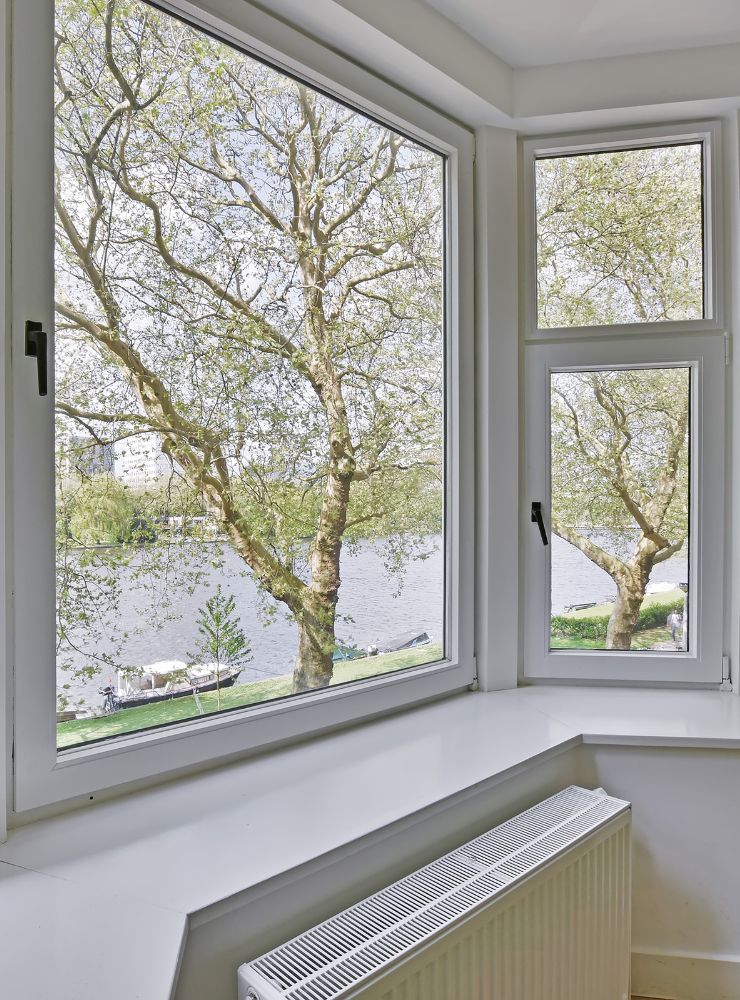
📷 Photo Needed
Completed window casing for medium-tall windows (90″ to 119″) — finished result showing professional quality
How Height Changes Window Casing #
Tall window casing work in the 90″ to 119″ range introduces several challenges. Here’s what’s different about a tall window casing project:
-
You need a step stool or stepladder. The top of a 90-119″
window sits 8 to 10+ feet from the floor (header height plus rough opening).
You cannot reach the header casing, top miters, or upper nailing from the
ground. -
Side casings are 7.5 to 10 feet long. Standard casing stock
(7-foot lengths) may not be long enough. You’ll need 10-foot or 12-foot
stock for each side piece. Verify material length before you start cutting. -
Longer pieces flex. A 9-foot piece of 2-1/4″ casing bows
under its own weight when held horizontally. This affects cutting accuracy
and makes it harder to hold the piece in position during nailing. -
More nails per side casing. The
core guide
calls for nails every 12-16″. On an 8-foot side casing, that’s 6-8 nails per
row instead of 3-4. More nailing points means more time holding alignment. -
A helper is useful but not required. Solo installs are
manageable in this range with some technique adjustments (see below).
📷 Photo Needed
How Height Changes Window Casing — photo illustrating this section
Additional Tools for Window Casing #
In addition to the core guide tools, tall window casing requires:
Everything in the
core guide tool list, plus:
-
Step stool or 4-foot stepladder — Sturdy enough to stand on
while nailing overhead. Follow OSHA portable ladder safety guidelines when working at height. A step stool works for windows up to ~100″; taller
windows in this range need a proper stepladder. -
Miter saw with adequate crosscut capacity — Confirm your
saw can handle the full width of the header casing in one cut. Most 10″
sliding miter saws cut up to 12″ wide; a 12″ slider handles up to 16″. If
your header piece is wider than your saw capacity, you’ll need to flip the
piece and complete the cut from the back side.
📷 Photo Needed
Tools and materials laid out for window casing for medium-tall windows (90″ to 119″) — everything needed before starting
Tall Window Casing Material Planning #
Standard window casing stock often comes in 7-foot lengths, which won’t cover a single side
piece for windows in this range. Before starting:
-
Measure your longest side casing, add 3 inches for waste, and order stock at
least that long. -
10-foot or 12-foot lengths are the right stock for this
window size. Most suppliers carry these in common profiles. -
If long stock isn’t available in your profile, This Old House recommends considering a
scarf joint — an angled splice where two shorter pieces
meet. Place the joint behind a curtain rod or at a natural visual break.
Scarf joints are an intermediate skill; if this is your first one, practice
on scrap first.
📷 Photo Needed
Material Planning — photo illustrating this section
What’s Different Step-by-Step #
Follow the core guide for the full process. Below are the tall window casing modifications for each step:
Follow the
core guide for
the complete process. These are the modifications for 90-119″ windows:
Steps 2, 6, 7 — No Significant Changes #
Step 2 (Measure and Cut Header): Same process — the header
width doesn’t change with window height.
Step 6 (Bottom Casing): Same process — the bottom is at the
same working height as a standard window.
Step 7 (Finish and Detail): Same techniques, but you’ll be on
a ladder for the upper joints and nail holes. Budget extra time for climbing
up and down.
Step 1: Inspect and Mark Reveal Lines #
Same
inspection and marking process, but you’ll need the ladder to mark the top jamb reveal and to inspect the
upper portion of the side jambs. Check for flush jambs along the full height —
a jamb that’s flush at waist level might be proud or recessed at 8 feet where
you can’t see it from the ground.
📷 Photo Needed
Inspect and Mark Reveal Lines — showing the key action and what the result should look like
Step 3: Install the Header #
Same positioning and nailing. The difference is elevation — you’re on a ladder
holding the header at 8-10 feet. Set up the ladder centered on the window so
you can reach both ends of the header without repositioning.
Solo technique: Tack a temporary finish nail partway into the
wall just below your header reveal mark on one side. Rest one end of the
header on the nail, align the other end, and nail from that end toward the
supported end. Remove the temporary nail after the header is secured.
📷 Photo Needed
Install the Header — showing the key action and what the result should look like
Step 4: Measure and Cut the Side Casings #
Same measurement and cutting technique, but
support long pieces during cutting. A 9-foot piece of casing
extending off one side of the miter saw will droop and affect cut accuracy.
Use a roller stand, sawhorse, or have a helper support the offcut end level
with the saw table.
📷 Photo Needed
Measure and Cut the Side Casings — showing the key action and what the result should look like
Step 5: Install the Side Casings #
Same gluing, positioning, and nailing. The challenge is holding a 7.5-10 foot window casing
piece plumb against the reveal marks while nailing from a ladder.
-
Start at the top. Align and glue the miter joint first,
then cross-nail it. The locked miter holds the top in position while you
work down the piece from the ladder to the floor. -
Reposition the ladder as you work down. Don’t overreach —
move the ladder to keep your nailing within comfortable arm’s reach. - For the lower half, you can step off the ladder and work from the floor.
📷 Photo Needed
Install the Side Casings — showing the key action and what the result should look like
Tall Window Casing Time Estimate #
The
core guide
estimates 20-30 minutes per standard window. For 90-119″ windows, plan
30-45 minutes per window. The extra time comes from ladder
repositioning, handling longer material, and additional nailing points — not
from any difference in technique.
📷 Photo Needed
Window Casing Time Estimate — photo illustrating this section
Quality Check — Additions #
After completing the core checklist, verify these tall window casing specifics:
After finishing window casing installation, complete the full
core guide quality checklist, then verify:
-
Side casings are straight along the full length — sight down the edge from
the bottom. Longer pieces have more room to bow between nail points. - Upper nail holes are filled — they’re above eye level and easy to skip.
-
Reveal is consistent from top to bottom on both sides — check with your
combination square at the top, middle, and bottom of each side casing, not
just at eye level.
📷 Photo Needed
Completed window casing for medium-tall windows (90″ to 119″) — close-up detail shots showing quality criteria being met
Troubleshooting Window Casing Problems #
These tall window casing problems are specific to the 90″ to 119″ range:
Side Casing Bows Away from the Wall #
Long casing pieces can bow outward between nail points, especially if the wall
has a slight depression. Add an extra nail midway between the existing nails
on the wall-framing row. If the wall behind is hollow (no framing), use a
construction adhesive dot behind the casing at the bow point before nailing.
Top Miter Opens While Nailing Down the Side #
The weight of the long side casing pulls the top miter apart as you nail the
lower section. Prevention: cross-nail the top miter thoroughly before nailing
anything else on the side piece. If it’s already opened, back out the lower
nails, re-close the miter with glue and cross-nails, then re-nail from top to
bottom.
Casing Stock Too Short for Side Pieces #
You measured after cutting and the 7-foot stock won’t cover the side. If you
have matching stock, you can make a scarf joint: cut both pieces at a
30-degree angle (not 45 — a shallower angle hides better), glue and nail the
splice, and position it low where furniture or curtains will conceal it.
Better solution: return the short stock and buy 10-foot or 12-foot lengths.
Related Tall Window Casing Guides #
-
Core Guide:
How to Case a Window Like a Pro
— Complete step-by-step process for all window sizes -
Case Window 3 (120″+)
— Windows with tops at 10 feet or higher: full stepladder, two-person recommended, heavy/long
stock


